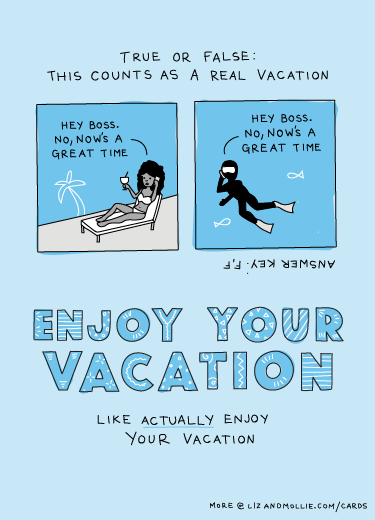
Until relatively recently, I was that person who, after 4 or 5 days on vacation, would start to feel anxious… about being on vacation.
I’d start to think about all the work that was piling up and the mess everything would be in when I got back, all the stress I’d feel recovering “lost time” from those days, or whatever.
Have you ever felt the same?
When you go on vacation, do you really go on vacation or do you spend your life looking at your phone, checking your email and thinking about the pending tasks you’ll have to return to as soon as your vacation is over… suffering in anticipation?
Or are you one of those people who finish their vacation feeling like they need a vacation from their vacation?
We often go on vacation but remain hypervigilant about our work activities. It doesn’t matter whether you’re working for others or on your own. Hypervigilance can be there in both cases, possibly for different reasons.
Once I understood the main reason behind my hypervigilance on vacation, it became easier to relax and enjoy it. I think I can say that the idea I’m about to share has really changed my life.
The idea is this: without realizing it, we have ingrained in us (and I’d venture to say it’s something cultural and very ingrained in our society) this belief that our value comes from the things we do. From our work. Our productivity. From the paycheck at the end of the month.
When we carry this belief with us, after three or four days on vacation, we start to feel a little uncomfortable. Although it’s good to stop and rest, there’s a part of us that inevitably begins to feel that we’re not complete, that we’re missing something, that we’re not doing enough. We start to feel that we’re not enough.
Here’s the problem with this belief: it’s completely wrong and distorted.
Because: our value is intrinsic. It doesn’t depend on the work we do, or how good we are at it, it doesn’t depend on the paycheck at the end of the month, it doesn’t even depend on having a job and being employed. It doesn’t depend on any of that, because it’s not conditional.
(And I know how unfamiliar this often sounds to our ears, because the messages we receive from society – even the way we’re praised, etc. seem to tell us exactly the opposite).
Perhaps it’s worth repeating: our value is
…intrinsic,
…innate,
…unconditional.
The second idea I want to share is this: there is something deeply wrong and dangerous about the notion that we are always supposed to be available, accessible and producing at work.
This notion is often imposed from the outside, but it’s also common among freelancers or small business owners (who self-impose this same pressure to do, do, do): because if you’re not working, you’re not producing, so you’re not earning! Wow, that’s so real for me!
But here’s the truth: it’s IMPOSSIBLE to keep getting good, excellent results when you don’t rest or take breaks. We may be able to manage for a while, but sooner or later tiredness and physical and/or mental exhaustion will get the better of us if we don’t practice the art of stopping and resting.
Imagination, creativity, innovation and the positive energy we bring to the things we do are not inexhaustible sources. They need to be fed by breaks, rest, new experiences and time to recharge. Practice the world-famous Italian technique of dolce far niente.
Doing absolutely nothing is vital.
(Do you realize that when you’re at your most tired and in need of a vacation, you become more impatient and even irritable with co-workers? Another point in favor of rest: it’s a balm for kindness and the way we relate to others!)
And if you don’t allow yourself this kind of expansion in our lives a few times a year, you’re giving up the ability to renew yourself.
You’re probably thinking: okay, Isa, well done, thanks for the information, but what I want to know is how I use it to enjoy the vacations better. How can I change my programming around anxiety and hypervigilance?
The first step is the hardest: we have to decide that we want and deserve to take a vacation to rest, revitalize and switch off. Because we often say that (even with some resentment), but we’re not really committed to that rest, because there’s a part of us that feels (or needs to feel) that we’re always needed at work.
The second step is to plan that rest. This involves defining and setting the necessary boundaries; letting people know what our intentions are for the vacation (for example, that we won’t be contactable except for emergencies, etc.); and delegating the tasks we need to delegate.
Here are some practical things you can do to protect your break space:
- Pre-set an absence message in your work email or voicemail. You can include specific instructions about how long you’ll be away and forward urgent situations to someone else if necessary.
- Take a break from your cell phone and social media. Most people pick up the phone hundreds of times a day without any specific intention in mind, just out of habit. A golden rule on vacation is to reduce the time we spend in front of our screens. If we find it difficult to make these concessions, we can determine intervals throughout the day to check email, social media, etc.
- Plan a vacation according to what you need and what makes you feel good. There are times when it feels good to be surrounded by people and others when we prefer something more private, in contact with nature. Find out what you need and don’t turn your vacation into an obligation: if you decide to be with other people, do it not out of a sense of duty, but because it makes you feel good.
- Opt for outdoor activities, preferably in nature. There are countless studies on the benefits of contact with nature to revitalize ourselves.In fact, the secret to feeling on vacation is to cultivate the art of being present. That is, our ability to be here, now, in this precise moment.Cultivating presence helps us make the most of the vacations, restore ourselves, re-energize ourselves, re-establish ourselves… (And by the way, what are social networks, emails and notifications doing? They rob us of that ability).Give yourself permission to disconnect from the rest of the world and enjoy the present moment.
Enjoy your vacation (if you can) and I’m going to do the same!