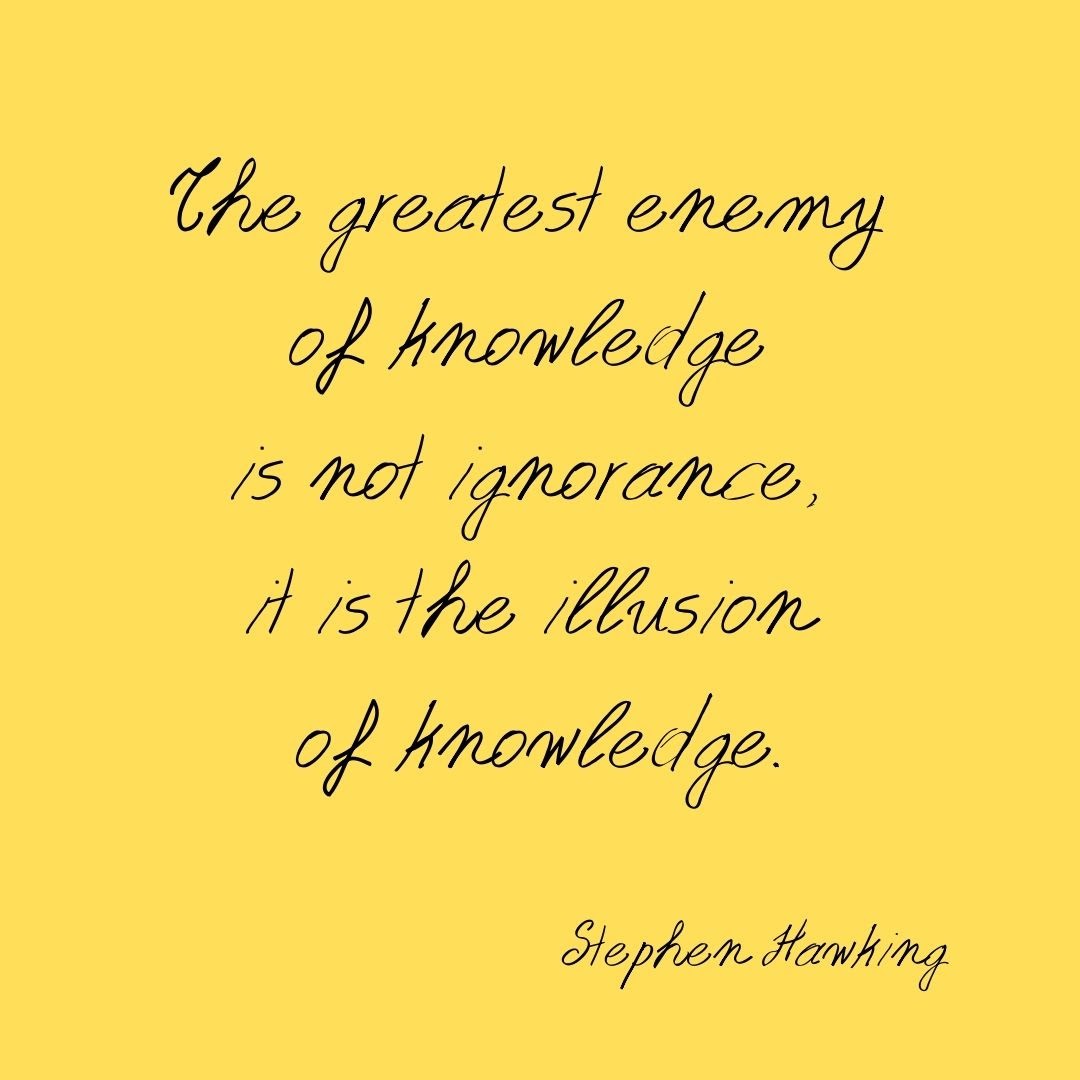
OK, my challenge to you today is to read Stephen Hawking’s quote and, instead of framing it in terms of other people’s behavior, reflect on how it might apply to yourself. 🤯
That’s what I did. And there have been several situations in my life where I was so sure of my convictions and what I knew that it would never have occurred to me that I could be so… wrong.
Knowledge is not only the acquisition and processing of new information, but also the process of recycling and removing information that no longer matters.
Unlearning beliefs, ideas and notions that we take as absolute truths and which may limit our ability to learn more and better is just as important as continually learning new information.
The other day, I read an opinion piece in which someone said that “there is only one truth”. It struck me as a very dangerous notion to have and, at the same time, I think that each one of us has carried this idea inside us at some point.
Otherwise, we wouldn’t see such heated and intolerant reactions to conflicting, different and opposing ideas every day.
Think about your life: is there any aspect in which you are convinced that there is only one truth, when maybe, just maybe, it’s not quite like that?
We can question and be more aware of our potential “blind spots” in knowledge, both in our personal and professional lives.
To do this, instead of looking at the world with this crystal-clear notion that there is only our truth, we can try embracing curiosity as a starting point instead. 🤔
It’s challenging, because it means giving up the idea that we’re right (and we all know how bad we are at dealing with uncertainty).
But replacing certainty with curiosity can be very rewarding and open doors to new perspectives.
Faced with challenges at work or in conflict situations, with family or friends, for example, try asking the following questions:
1. How could I see this from another perspective (or from the other person’s perspective)?
2. What might I not be seeing that could be important to better understand this problem/situation?
3. What might I be taking for granted that might not be entirely true?
The mere act of stopping and asking questions like these puts us on a level of readiness to access other levels of information.
And also more tolerance and empathy. And I think we all need a bit more of both.
The extra challenge would be to reflect on the following question:
in what situations in your life (personal or professional) could it be useful to apply these questions?